
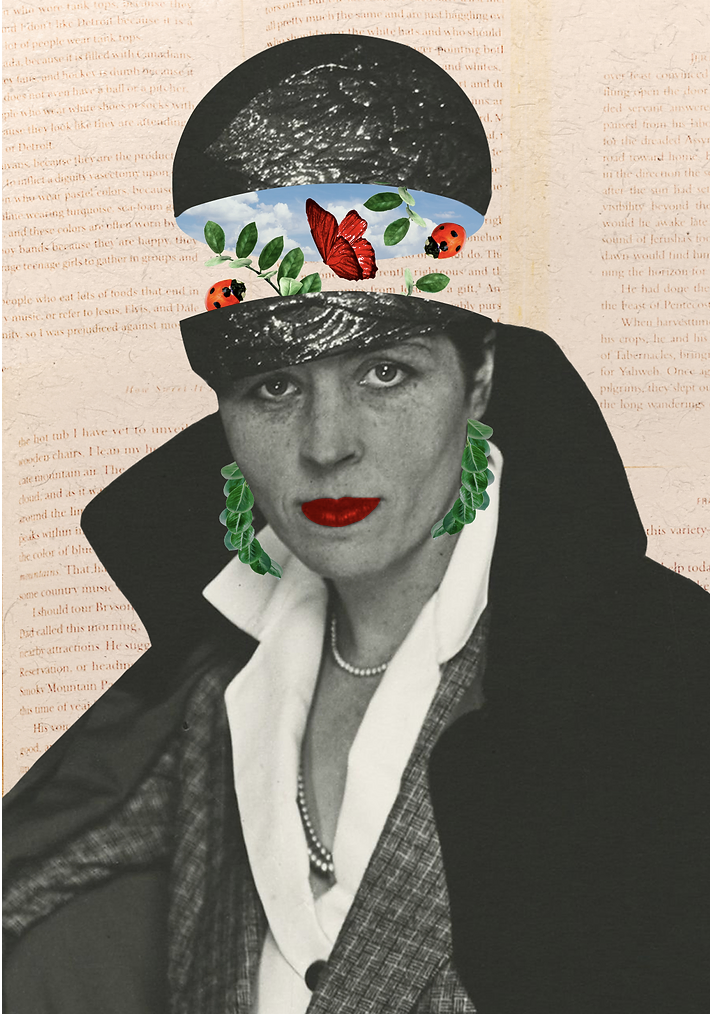
DJUNA BARNES
Cornwall-on-Hudson, New York, 1892 — New York, 1982
Born near Cornwall-on-Hudson, New York, Djuna Barnes was one of the most formally daring and culturally prescient artists of the modernist era — a writer, illustrator, journalist, and playwright whose work defied easy classification across nearly seven decades. Educated at the Pratt Institute and the Art Students League, she launched her career in Greenwich Village in 1913 as a freelance journalist and illustrator, contributing to the Brooklyn Daily Eagle, Vanity Fair, and Vogue, and publishing the illustrated poetry collection The Book of Repulsive Women (1915). Her 1922 interview with James Joyce for Vanity Fair became one of the most celebrated literary portraits of its era.
In 1921, a commission with McCall's brought Barnes to Paris, where she spent the next decade at the center of the Left Bank expatriate community. Her circle encompassed T.S. Eliot, Mina Loy, Natalie Barney, Radclyffe Hall, Berenice Abbott, and Baroness Elsa von Freytag-Loringhoven — with whom she shared both a romantic and a mutual publishing commitment. She had been friends with Peggy Guggenheim since their Paris years, spending summers at Guggenheim's home in Devon in 1932 and 1933. Her satirical Ladies Almanack (1928) mapped the lesbian salon culture of the rue Jacob; her masterpiece, Nightwood (1936), championed by T.S. Eliot and shaped in collaboration with Emily Coleman, remains a landmark of queer modernist literature — unflinching in its exploration of non-normative desire, exile, and identity. Her illustrated work Portrait of Alice was included in the Exhibition by 31 Women (1943).
Barnes returned to New York permanently in 1940, retreating to a small apartment at 5 Patchin Place in Greenwich Village, where she would live as a near-recluse until her death in 1982. Her legacy has undergone sustained scholarly reassessment: Across the Pane: The Art of Djuna Barnes (University of Maryland Art Gallery, 2020) reexamined her visual practice in full; Dalkey Archive Press reissued Ryder and McNally Editions published the story collection I Am Alien to Life as part of a broader critical renaissance in 2024. Scholars in queer theory, feminist modernism, and transnational literature continue to position Nightwood as a foundational text, while the International Djuna Barnes Society, founded in 2018, sustains a growing global field of Barnes studies. Her work reached new international audiences through 31 Mujeres, organized by Fundación MAPFRE and shown first in Madrid (2024 – 2025), then at the Museu de Arte Contemporânea MAC/CCB in Lisbon (2025). The exhibition featured an illustration from The Book of Repulsive Women (1915) alongside works by all thirty-one original participants, drawn from The 31 Women Collection.
Work by Djuna Barnes is maintained as part of the 31 Women Collection to preserve the legacy of the first all-women's exhibition in the United States on record and to maintain Barnes’ contributions in the record of art history.