
ELSA VON FREYTAG-LORINGHOVEN
Swinemünde, Pomerania, 1874 — Paris, 1927
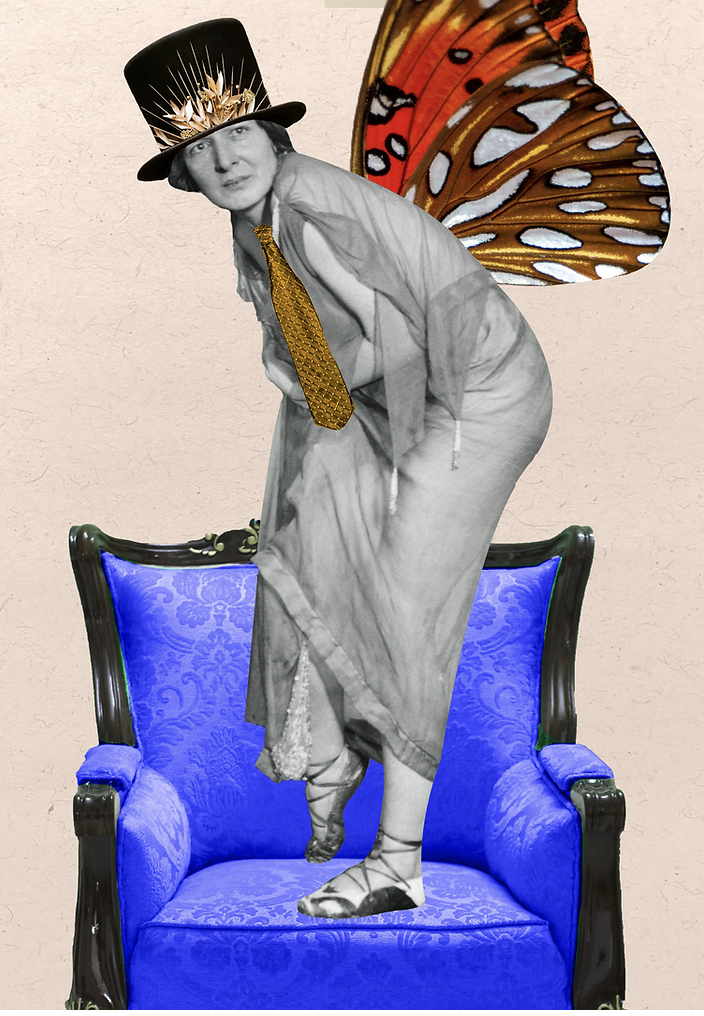
Born Else Hildegard Plötz on July 12, 1874, in what is now Świnoujście, Poland, the Baroness Elsa von Freytag-Loringhoven was among the most radical and irreducible figures of the transatlantic avant-garde. Described by Jane Heap of The Little Review as "the first American Dada," she did not merely participate in the movement, she embodied it, treating her own body as both medium and manifesto. Marcel Duchamp, her peer and sometimes collaborator, declared: "She is not a futurist. She is the future."
After training as an actress and vaudeville performer in Berlin, Munich, and Italy, she arrived in New York in 1913, acquiring her baronial title upon marrying Baron Leopold von Freytag-Loringhoven, shortly thereafter returned to Europe and died in the war. She supported herself as an artist's model and with factory work, all while producing an extraordinary body of found-object sculpture, experimental poetry, and body-based performance at the center of the Greenwich Village avant-garde. Her circle encompassed Duchamp, Man Ray, William Carlos Williams, Mina Loy, Berenice Abbott, and Djuna Barnes — with whom she shared both a romantic bond and a mutual commitment to each other's work. She contributed regularly to The Little Review and Others, her typographically inventive, sexually frank poetry anticipating the Beats and the confessional poets by several decades.
Her found-object sculpture God (c. 1917), a cast-iron plumbing trap mounted on a wooden miter box — long misattributed to Morton Livingston Schamberg — is now co-credited to Freytag-Loringhoven by the Philadelphia Museum of Art. The parallels between God and Duchamp's Fountain (1917) have generated one of art history's most consequential attribution debates: recent research by art historian Glyn Thompson, covered by Artnet News in 2023, identifies the handwriting on the urinal as Freytag-Loringhoven's and situates its manufacture in Philadelphia, where she — not Duchamp — was residing at the time. The debate remains unresolved but has substantially recalibrated scholarly understanding of the readymade's origins.
Her work Object (1926) was included in Peggy Guggenheim's Exhibition by 31 Women (1943) posthumously. She died in Paris in December 1927 under unresolved circumstances. Her poetry was not collected until Body Sweats: The Uncensored Writings of Elsa von Freytag-Loringhoven (MIT Press, 2011), named a notable art book of the year by The New York Times. Recent institutional responses to her legacy include The Baroness at Mimosa House, London (2022), The Baroness Elsa Project at the Carleton University Art Gallery and Owens Art Gallery (2023–24), and the installation Alreadymade by Barbara Visser at Kunsthaus Zürich (2024) — each positioning her as a vital, unfinished presence in contemporary art. Her work, Forgotten Like this Parapluice am I by You Faithless Bernice (1923-1924), was included in 31 Mujeres at Fundación MAPFRE, Madrid (2024–25) and 31 Mulheres at MAC/CCB, Lisbon (2025). Freytag-Loringhoven papers are held in the Special Collections and University Archives at the University of Maryland.
Work by Elsa von Freytag-Loringhoven is maintained as part of the 31 Women Collection to preserve the legacy of the first all-women's exhibition in the United States on record and to maintain Freytag-Loringhoven’s contributions in the record of art history.