
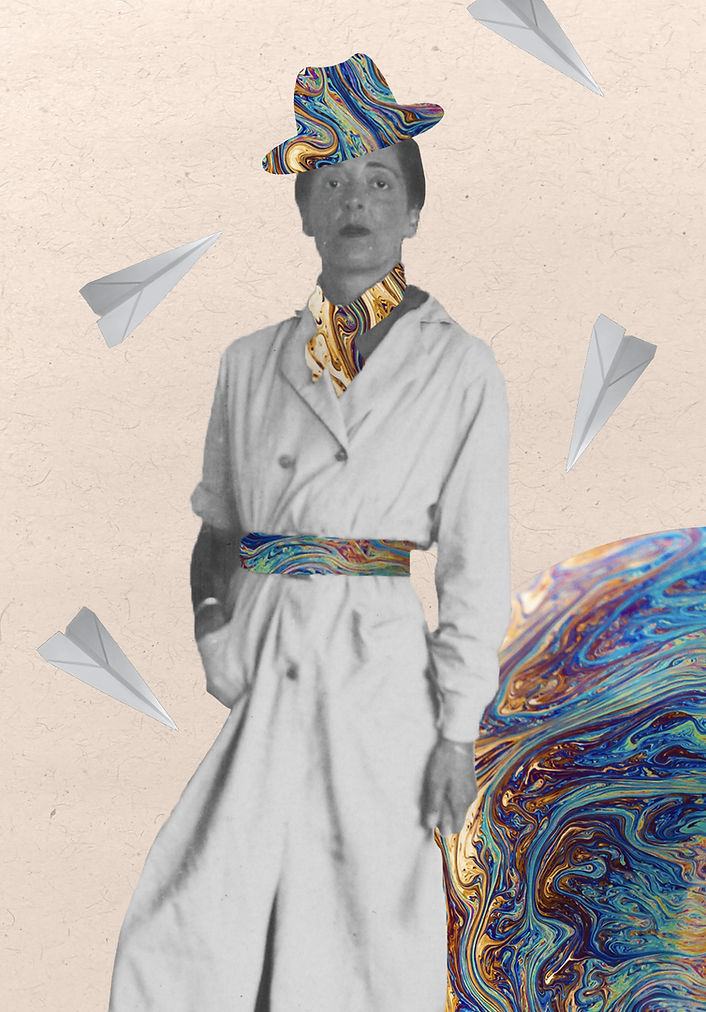
EYRE (ELIZABETH) DE LANUX
Johnstown, Pennsylvania, 1894 — New York, 1996
Born Elizabeth Eyre on March 20, 1894, in Johnstown, Pennsylvania, into a family steeped in the arts — her uncle the Philadelphia architect Wilson Eyre, her aunt the sculptor Louisa Lear Eyre — Elizabeth de Lanux became one of the most versatile and under-recognized creative figures of interwar Paris. A painter, furniture designer, fresco artist, interior decorator, and writer, she worked across disciplines with a restless intelligence that resists easy categorization.
Educated at the Art Students League in New York under George Bridgman, Robert Henri, Charles Hawthorne, and others, she debuted publicly in the inaugural exhibition of the Society of Independent Artists in 1917, showing two paintings, L'Arlesienne and Allegro. The following year she married French writer and diplomat Pierre Combret de Lanux, and the couple settled in Paris. There she continued her studies at the Académie Ranson with Maurice Denis and at the Académie Colarossi, and eventually became a fixture at writer and salon hostess Natalie Clifford Barney's celebrated Friday salons on the rue Jacob — a relationship that extended into a significant romantic partnership lasting into the mid-1920s. Her social world encompassed Brancusi, Hemingway, Ezra Pound, Picasso, Djuna Barnes, Mina Loy, and Gertrude Stein.
The most consequential chapter of her design career unfolded from 1927 to 1933, when she partnered with British carpet designer Evelyn Wyld to produce modernist furniture in lacquer, glass, cowhide, and wood. Together, they exhibited at the Artistes-Décorateurs (1928,1929) and the inaugural Société Union des Artistes Modernes (1930), placing their work in direct dialogue with Eileen Gray and Jean-Michel Frank as one of the few women-led design practices in Paris at the time. Her fresco Persiennes, Persiennes (1942) was included in Peggy Guggenheim's Exhibition by 31 Women (1943).
De Lanux lived to 102, continuing to write and paint into her final decades — contributing fiction to La Nouvelle Revue Française and Harper's Bazaar, and producing frescoes in Rome and North Africa with her partner Paolo Casagrande. She is now the subject of renewed scholarly attention. Her furniture and rugs are actively traded at auction and reassessed within the canon of women modernist designers, and her column "Letters from Elizabeth" in Town and Country is now widely considered primary document of the modernist milieu. Her papers are held at the Archives of American Art, Smithsonian Institution. Her rug Attrape-rêves (1927), was included in 31 Mujeres at Fundación MAPFRE, Madrid (2024–25) and 31 Mulheres at the Museu de Arte Contemporânea MAC/CCB, Lisbon (2025).
Work by Eyre de Lanux is maintained as part of the 31 Women Collection to preserve the legacy of the first all-women's exhibition in the United States on record and to maintain de Lanux's contributions in the record of art history.