
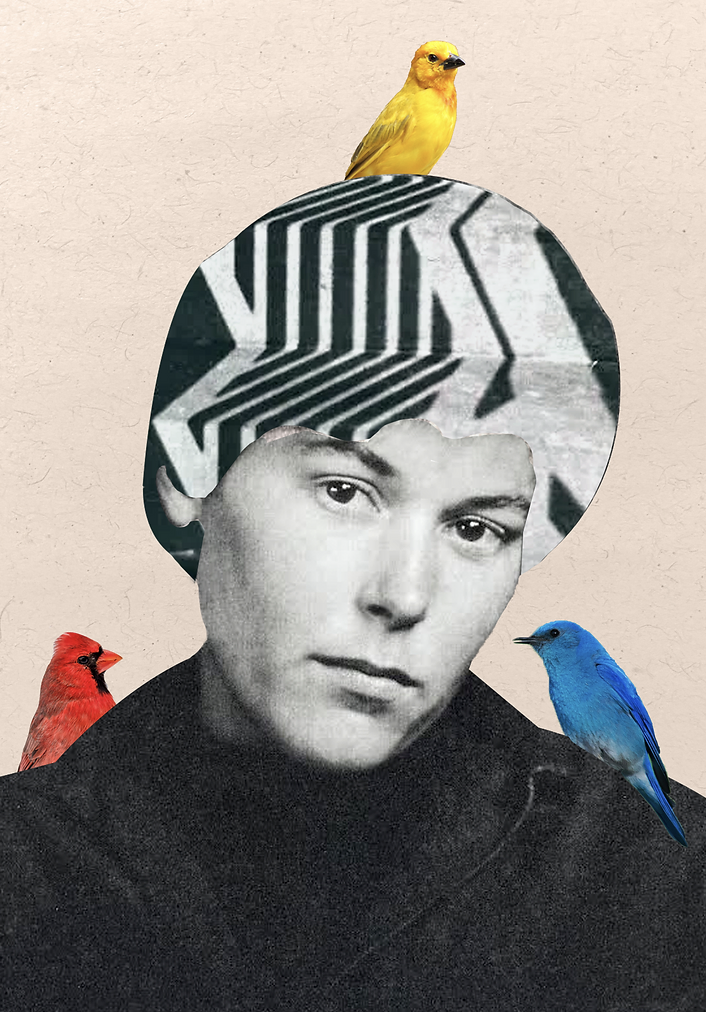
GRETCHEN SCHOENINGER CORAZZO
Ravinia, Illinois, 1913 — Jackson Township, Indiana, 2016
Born in Ravinia, Illinois, on December 18, 1913, Gretchen Schoeninger Corazzo pursued one of the longest and most materially inventive careers among the artists of her generation — a practice spanning more than seven decades that encompassed sculpture, photography, printmaking, weaving, collage, and the seed paintings for which she became celebrated in the American Midwest. Her father, an entrepreneur who negotiated the transfer of the rotogravure printing process from Germany to the United States, provided the family with an unconventional intellectual environment from early childhood. A formative stay near Stuttgart in 1922–23, where the family lodged with Anton Lang — the celebrated Christus figure of the Oberammergau Passion Play and an art potter — sparked her lifelong instinct for working directly with materials. "After this," she later recalled, "I always had a piece of mud in my hands."
In 1925, the family moved to Carmel, California, an artist's colony, where their home became a gathering place for local artists. In 1932, the twenty-year-old John Cage arrived in Carmel with nowhere to house a piano; he was allowed to use the Schoeningers' Steinway, and Gretchen became firm friends with him, spending hours in conversation. It was also in Carmel that she befriended Xenia Kashevaroff, who would soon become Cage's wife. In her early twenties, Schoeninger moved to Los Angeles to attend the Chouinard School of Art, before enrolling at the New Bauhaus in Chicago in its inaugural year of 1937, studying photography with László Moholy-Nagy and sculpture with Alexander Archipenko. It was there that she met her future husband, the French-born painter and architect Alexander Corazzo.
The New Bauhaus was among the most consequential art schools of the twentieth century, transplanting the Bauhaus pedagogical model to the United States under Moholy-Nagy's direction and training a generation of artists, designers, and photographers who would define postwar American modernism. During the war years, Schoeninger produced dioramas for the Field Museum and Red Cross posters, while Alexander worked for the Works Progress Administration. When the Cages moved to Chicago, they lived as neighbors of the Corazzos; their broader social world encompassed John Cage, Xenia Cage, Moholy-Nagy, Mies van der Rohe, and Peggy Guggenheim.
Her work Abstraction (1942), shown at the San Francisco Museum of Modern Art that year, was included in Guggenheim's Exhibition by 31 Women (1943). After the war, the couple settled on a farm in rural Jackson Township, Indiana, where Schoeninger continued to make cast concrete sculpture, prints under Bill DeHoff at Valparaiso University, weavings from her sheep's wool, and intricate seed paintings inspired by her garden and surrounding landscape. John Cage wrote poems about the Corazzos.
Her legacy has received meaningful institutional recognition in recent years. She was included in Cubism Collage Cybergrams Concrete: 4 Artists from Moholy-Nagy's School at the Ukrainian Institute of Modern Art, Chicago (2016–2017), which highlighted her place within the New Bauhaus tradition alongside her husband, Alexander. Her photograph, Negative Exposure (1937), was further contextualized in 31 Mujeres at Fundación MAPFRE in Madrid (2024-2025), and subsequently in 31 Mulheres at the Museu de Arte Contemporânea MAC/CCB in Lisbon (2025), as part of the most comprehensive institutional reappraisal of the original Guggenheim exhibition to date. Her photography is held in the permanent collection of the Art Institute of Chicago.
Work by Gretchen Schoeninger is maintained as part of the 31 Women Collection to preserve the legacy of the first all-women's exhibition in the United States on record and to maintain Schoeninger's contributions in the record of art history.