
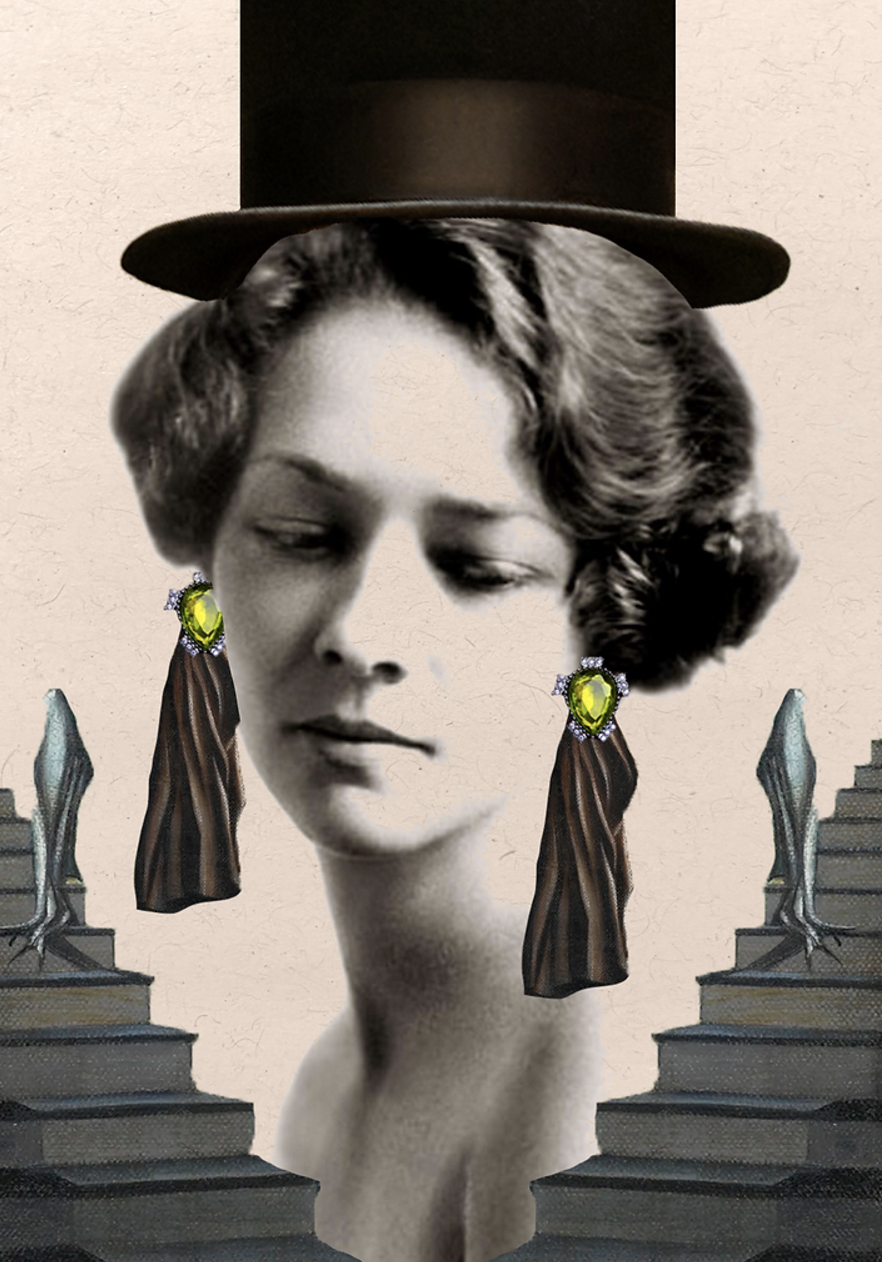
KAY SAGE
Watervliet, New York, 1898 — Woodbury, Connecticut, 1963
Kay Sage occupies a distinctive position within the history of transatlantic Surrealism as a painter whose desolate, architecturally scaffolded canvases articulate a poetics of isolation and psychic containment that retains a startling immediacy. Born Katherine Linn Sage in Watervliet, New York, she came of age between continents, receiving her formal training in Rome during the 1920s before her decisive encounter with the Parisian avant-garde in the late 1930s, where she shed academic conventions and forged the austere visual language for which she became known.
Recent scholarship has substantially revised the terms of her reception. Where earlier accounts framed Sage largely through her 1940 marriage to Yves Tanguy, contemporary reassessments — shaped by feminist art history and transnational approaches to modernism — foreground her independent agency and indispensable role as a cultural mediator. During World War II, she was instrumental in facilitating the emigration of European artists and intellectuals to the United States, and her 1940 debut at the Pierre Matisse Gallery announced a formidable new presence within New York's evolving Surrealist milieu. Her painting At the Appointed Time (1942) was shown in Guggenheim's Exhibition by 31 Women (1943), and she returned to Guggenheim's for The Women (1945) — the second all-female exhibition at Art of This Century, confirming her central position within the movement's New York chapter. Her painting, The Fourteen Daggers (1942), was presented in 31 Mujeres at Fundación MAPFRE, Madrid (2024–25) and 31 Mulheres at MAC/CCB, Lisbon (2025).
Her mature paintings — suspended draperies, ambiguous architectures, figures dissolved into geometric shadow — resist easy categorization. Works such as Arithmetic of Wind (1947) exemplify what scholars now term her "constructivist Surrealism": fragmented forms and architectural motifs coalesce into compositions of spare psychological intensity that evoke dislocation, enclosure, and forces just beyond the threshold of the visible. Following Tanguy's death in 1955, Sage's output diminished amid declining health, yet her late works sustain an intensified introspection that deepens, rather than closes, her visual project.
Today, Sage is increasingly recognized as central to Surrealism's American expansion. The Mattatuck Museum in Waterbury, Connecticut holds the largest institutional collection of her work. Recent exhibitions, including a 2023 show at Helly Nahmad Gallery, continue to affirm her critical standing, and the ongoing Kay Sage Catalogue Raisonné project provides the scholarly infrastructure for sustained reassessment of her contribution to modernism.
Work by Kay Sage is maintained as part of the 31 Women Collection to preserve the legacy of the first all-women's exhibition in the United States on record and to maintain Sage's contributions in the record of art history.