
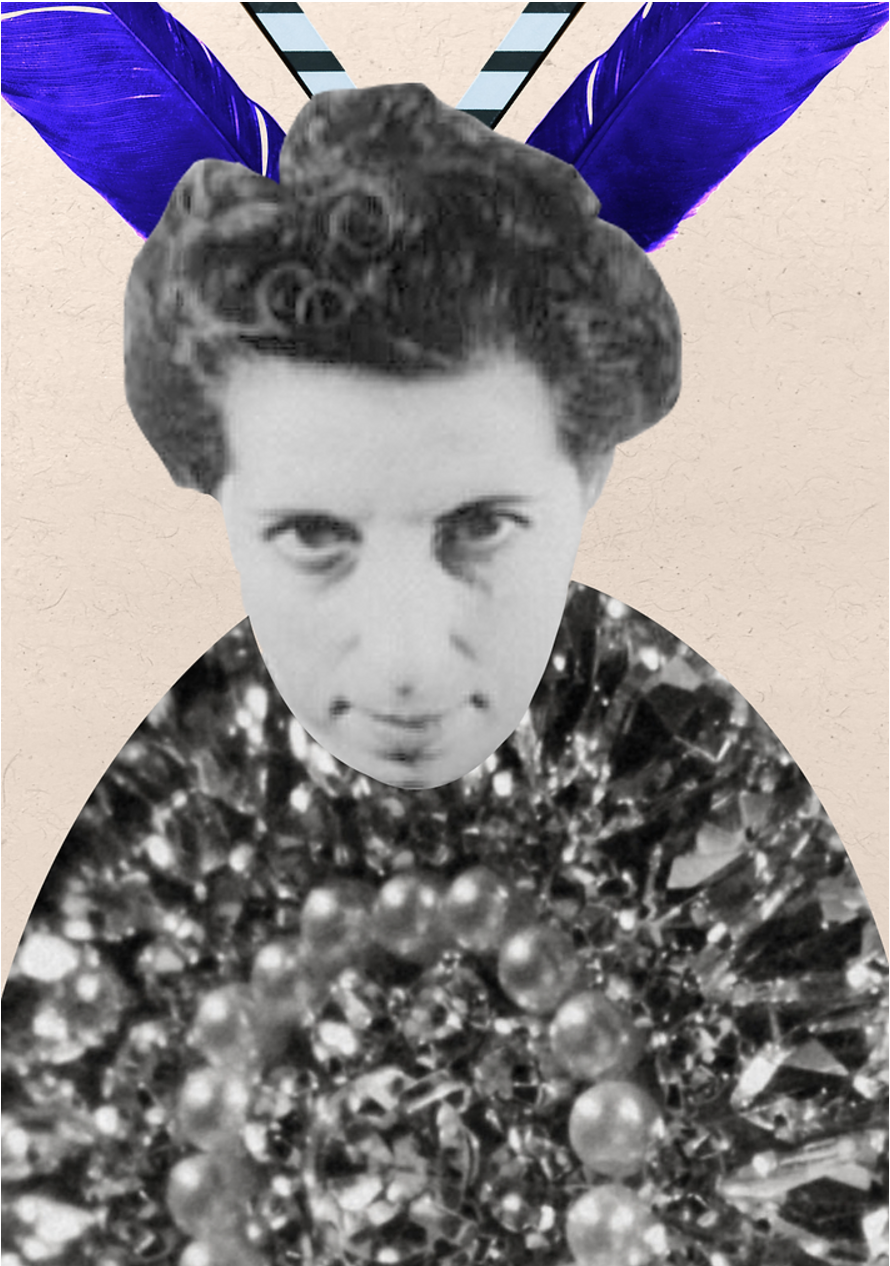
MILENA PAVLOVIĆ BARILLI
Požarevac, Serbia, 1909 — New York, 1945
Born in Požarevac, Serbia, to Italian composer, poet, and music critic Bruno Barilli and a mother descended from the Karađorđević dynasty, Danica Pavlović-Barili, Milena Pavlović Barilli was the most notable female artist of Serbian modernism and one of the most singular transatlantic figures of her generation. In a career of barely eighteen years, she produced over four hundred known works and moved between Belgrade, Munich, Paris, and New York with a restless creative intelligence that resists any single movement or national tradition. Her work has been described as soft surrealism, magical realism, and metaphysical painting, featuring dreamlike compositions of veiled figures, angels, Venus statues, and Harlequins, inflected by the Italian Renaissance, Giorgio de Chirico, and the surrealist circles she inhabited in Paris.
Pavlović Barilli formation was exceptional in rigor and breadth. After graduating from the School of Fine Arts in Belgrade (1922–26), she studied at the Munich Academy under Hugo von Habermann and Franz von Stuck. In Paris, she exhibited at the Galerie Bernheim Jeune (1939), where critics of the stature of de Chirico and Paul Valéry praised her work, with Valéry reportedly remarking, "Milena, you paint better than I write." Her first American exhibition at New York’s Julien Levy Gallery in March 1940 was introduced by Vanity Fair art editor Frank Crowninshield, who described her work as a unique phenomenon combining European tradition with the contemporary demands of the United States. Pavlović Barilli became a regular illustrator for Vogue, Harper's Bazaar, and Glamour, and the only Serbian artist to feature on the cover of US Vogue. In 1944, she designed sets and costumes for Gian Carlo Menotti's ballet Sebastian — her closest friend's work — and was commissioned to design A Midsummer Night's Dream, a project left unfinished at her death.
Her painting Insomnia (1942) was shown in Peggy Guggenheim's Exhibition by 31 Women (1943); its current location is unknown. Pavlović Barilli died suddenly on March 6, 1945, in her New York apartment. Her painting, Juno and Vulcan (1936), was presented in 31 Mujeres at Fundación MAPFRE, Madrid (2024–25), and in 31 Mulheres at MAC/CCB, Lisbon (2025). Her legacy is preserved at the Milena Pavlović Barilli Gallery in Požarevac, her birthplace, which her mother converted into a museum in 1962. The gallery holds 894 of her works and organizes a biennial international art exhibition in her name.
Work by Milena Pavlović Barilli is maintained as part of the 31 Women Collection to preserve the legacy of the first all-women's exhibition in the United States on record and to maintain Pavlović Barilli's contributions in the record of art history.